Sunday, April 14, 2013

Twitter and Apple prepare to launch music services

Apple and Twitter are both expected to make significant incursions into the music space in the near future in moves that could challenge Spotify, Pandora and other independent music services.

Apple is understood to be preparing a music streaming service that would challenge existing ones such as Spotify and Pandora in the US, after reports said that it was close to securing licensing deals with Universal Music and Warner Music, two of the three major music labels. Negotiations with the third, Sony Music, are said to be “less advanced”, while there is no indication of independent labels’ willingness to sign.

But industry gossip points to a launch of the service, perhaps called “iRadio”, later this year. That would cement Apple’s position in the digital music space, where its iTunes Music Store â€" which is ten years old this month â€" already makes it the biggest music retailer in the world.

Music streaming is a fast-growing space, where the number of subscribers grew 44% in 2012 to 20m.

Twitter meanwhile is expected to launch a dedicated product optimised for music, being readied by Twitter for launch at this weekend’s Coachella music festival, where artists including Blur will be playing.

Twitter Music, which is being teased with a holding page, is thought to offer users a version of Twitter optimised for music, including enhanced player tools supporting Soundcloud and iTunes, rich follower tools for favourite bands, suggestions and trends, and a recommendation service between friends.

The service has been built by the We Are Hunted team, an Australian music discovery and sharing tool quietly acquired by Twitter this year. The deal was only announced yesterday with a statement on the a href=”"We Are Hunted/a site which said: “While we are shutting down wearehunted.com, we will continue to create services that will delight you, as part of the Twitter team.

“There’s no question that Twitter and music go well together. Artists turn to Twitter first to connect with fans, and people share and discover new songs and albums every day. We can’t wait to share what we’ve been working on at Twitter … you will hear more from us.”

Apple’s negotiations with labels were reported by a href=”"The Verge/a, noting that talks with Sony were less advanced. Apple hopes that iRadio, as the planned new service had been dubbed, will help push download sales by helping users discover new music â€" implying that its Genius recommendation tool and Ping network have not done the job.

Negotiations have not run smoothly; Apple had initially been pushing for a royalty rate of around 6c per 100 streamed songs â€" roughly half what rival service Pandora currently pays. Current negotiations have doubled that rate. There has been speculation that the basic iRadio service would be free and ad-supported, and launch at Apple’s next developer conference in summer.

Music analyst Alice Enders said that Twitter Music was unlikely to present any challenge to the mainstream commercial music space. “It is not a game changer â€" it’s niche, a recommendation-based service for people that aren’t representative of the billions of people that consume music,” she said. A commission-based system for sales on a third-party site would be an unlikely revenue stream, she said, because it would drive users off the Twitter platform, so further promotional advertising products are the most likely revenue streams for the service.

But Apple’s service was most likely to present a challenge to Pandora, the online radio service that now claims to be used by as much as one third of the US online audience, she said.

“The real question is Apple going to attract users away from Pandora,” said Enders. “It’s a big decision for the recorded music industry whether Apple should become a subscription service, noting that the all-you-can-eat service seems to be the nirvana for the music industry even though there is the potential to cannibalise download sales.”

She added that though successful in the US, the Pandora model has not achieved that scale in other markets which would limit the potential for an Apple product based on that model.

Soundcloud declined to comment on Twitter Music, and Twitter said it could not comment beyond the statement on We Are Hunted‘s site.

Apple did not respond to a request for comment. Universal Music made no comment.

Psy Is No 'Gentleman' In New Music Video

Evidenced by Psy’s music video for “Gentleman,” the follow-up to his zeitgeist-busting hit “Gangnam Style,” the Korean pop star has pretty clearly let mega-success go to his head.

In the four-minute clip for his new single, which debuted Saturday (April 13), Psy parades through a series of chic restaurants and shops, playing pranks on female companions eager to join his entourage.

The song’s throbbing electro beat immediately recalls the irresistible catchiness of “Gangnam Style,” but Psy’s performance only showcases how much sillier he’s become in the wake of his emergence as a worldwide phenomenon. Evidently he’s so rich now he can afford to get his tongue surgically embedded in his cheek. Although he expands upon the garish lifestyle he chronicled in the YouTube-record-breaking clip for its predecessor, “Gentleman” effectively parodies a rich heel, subjecting ladies within his celebrity orbit to “Billy Madison”-style gags like pulling chairs out from beneath them and speeding up treadmills until they fall off.

Although stink-palming a girl in a library ranks among the video’s best moments, his “performance” of an (admittedly unclear) English language lyric is the one we love best: As he says either “Wet Psy!” or “West Side” (and we hope it’s the former), Psy and two bikini-clad women are catapulted into a swimming pool. Meanwhile, he gleefully terrorizes a kids’ soccer game and holds up an unfortunate elevator passenger who desperately needs to pee before meeting his match â€" a buxom gym rat who gives him a taste of his own medicine.

One-hit wonder or not, Psy is clearly savvy enough to take advantage of his 15 minutes of fame, even if he doesn’t seem to take it too seriously. Even before the video cuts to behind-the-scenes footage of Psy laughing his way through its goofiest moments, he simultaneously satirizes superstardom and attempts to enhance his own, aiming to re-create “Gangnam Style” magic with a new dance routine. Will it work? I guess we’ll know when Matt Lauer starts doing it on the “Today” show.

Tune in to the 2013 MTV Movie Awards Sunday at 9 p.m. when host Rebel Wilson takes the stage at the Sony Pictures Studios lot in Culver City, California. But first, don’t miss our live red-carpet pre-show at 8:30 p.m., and be sure to watch our All Access Live streaming cameras all night long.

Jay-Z's Obama Lyrics On 'Open Letter' Provoke White House Response

CUBA-US-BEYONCE

By Sowmya Krishnamurthy

Yesterday, Jay-Z released the new track “Open Letter,” in which he shouts out his friend President Barack Obama, and it’s actually provoked a response from the White House.

Hov fired back at critics who blasted his recent trip to Cuba with wife Beyonce and spoke of a conversation with Obama about getting the POTUS impeached. “Obama said, Chill, you gonna get me impeached/ You don’t need this shit anyway/Chill with me on the beach,’” Hov raps.

The White House is going on the record, denying that Obama spoke to Jay-Z about his Cuba trip. White House Press Secretary Jay Carney told White House reporters “the only reason Jay-Z implicated Obama in his new song is because it’s hard to find something that rhymes with treasury,” per TMZ.

TMZ shares that Carney claims Barack had no contact with Jay-Z about the Cuba trip and it was handled by the Treasury Dept.

MTV News reported that Jay and Beyonce had proper papers for their recent Cuban excursion and that the cultural trip was fully licensed by the Treasury, according to an unnamed source familiar with the pair’s itinerary.

Related
Stacey Dash’s Criticism Of Jay-Z Falls On Deaf Ears

Tags ,

Icy clouds over Titan's south pole hint that fall has come

NASA’s Cassini spacecraft has beamed back some very interesting images of Saturn’s largest moon Titan. The images were sent back by the Cassini spacecraft and show that an icy cloud is beginning to grow over the south pole of the moon. NASA says that that icy cloud indicates that fall has begun on Titan’s southern hemisphere.

titan1

Scientists and researchers don’t know what the cloud is made up of, but a similar cloud has been dissipating over Titan’s north pole where springtime has begun. The NASA researchers associate the cloud forming over the southern pole of the moon with winter weather. NASA says that the interesting thing about the cloud forming over the south pole is that this is the first time this sort of cloud has been detected anywhere other than the north pole of the moon.

Titan is very interesting to astronomers and scientists, it is the second largest moon in the entire solar system. Titan is also the only moon that has clouds and a dense atmosphere similar to a planet. Observations made by the Cassini spacecraft have noted that warmer air from the southern hemisphere of the moon rises into the atmosphere and then gets dumped on the moon’s North pole.

As that air descends from high in the atmosphere to the North pole of Titan it cools and forms the icy cloud. While here on earth we get several seasons in a single calendar year, Titan has a much longer seasonal pattern. The north pole of Titan begin transitioning from winter to spring in August of 2009. However, the first signs of the ice cloud in the southern hemisphere weren’t spotted until July of 2012. While scientists don’t know what the clouds on Titan are made from, they do know a few things the cloud cover isn’t made from. Scientists have ruled out chemicals such as methane, ethane, and hydrogen cyanide.

[via Space.com]

Half-Human, Half Ape Ancestor Walked Pigeon-Toed

Two million years ago in South Africa, part-human and part-ape-like individuals existed — and now we know what they looked like and how they behaved: They had a primitive, pigeon-toed gait, human-like front teeth, ate mostly veggies and spent a lot of time swinging in the trees.

The species, Australopithecus sediba, is a striking example of human evolution, conclude six papers published in the journal Science. Taken together, the papers describe how Au. sediba looked, walked, chewed and moved.

“Sediba shows a strange mix of primitive australopithecine traits and derived Homo traits — face and anterior dentition like Homo, shape of the cranium like Homo, other parts of the face and size of the cranium like an australopithecine, arms like an australopithecine, pelvis and lower limbs like Homo and feet and ankles like an australopithecine,” project leader Lee Berger told Discovery News.

PHOTOS: Faces of Our Ancestors

“It does look like a good ‘transitional’ fossil, doesn’t it?” added Berger, who is a researcher in the Wits Evolutionary Studies Institute at the University of the Witwatersrand. He named the species, which was found at a site called Malapa, near Johannesburg.

The tooth study found that Au. sediba was closely related to Au. africanus, which lived until about 2.1 million years ago. These species, in turn, shared numerous dental similarities with Homo erectus, an early human species.

“All of the research so far shows that sediba had a mosaic of primitive traits and newer traits that suggest it was a bridge between earlier australopiths and the first humans,” said Debbie Guatelli-Steinberg, co-author of one of the studies and a professor of anthropology at Ohio State University.

NEWS: ‘Ardi,’ Oldest Human Ancestor, Unveiled

Prior research determined what Au. sediba ate.

Peter Schmid of the University of Zurich, who also analyzed this species’ remains, shared that the early probable ancestor was not a carnivore.

“Microscopic elements of plants were found in the tartar of the teeth of Au. sediba,” Schmid told Discovery News. “It was largely a vegetarian and shows a rather human-like chewing apparatus.”

In terms of how it walked, Schmid and the other researchers explained that Au. sediba had a small heel resembling that of a chimp. It walked rather awkwardly — with an inward rotation of the knee and hip, with its feet slightly twisted. The scientists conclude that this pigeon-toed way of walking on two limbs might have been an evolutionary compromise between walking upright and tree climbing.

Such a detailed understanding of these movements is possible because remains for a female Au. sediba preserve her heel, ankle, knee, hip and lower back. In contrast, the famous “Lucy” skeleton, representative of the species Au. afarensis, only preserves a hip and ankle.

Yet another new study analyzed Au. sediba’s upper limbs. They were “primitive,” meaning more like those of an ape, suggesting that these individuals still spent some time swinging and climbing in trees.

This again makes Au. sediba a good candidate as a transitional species, because it appears to have spent most of its time on the ground, but it hadn’t entirely left the trees yet.

“The terrestrial adaptation was much more evolved, but there are indications that it had still a large part of climbing in its locomotor spectrum,” Schmid explained.

All in all, the papers make a strong case that early human evolution took place in South Africa following an expected sequential manner, from more ape-like to more human-associated characteristics.

The case isn’t closed yet, however, as still other researchers believe that additional australopithecines, such as Lucy, gave rise to our ancestors. Lucy’s species has only been found in northern Africa so far.

Africa was clearly a hotbed of early human evolution, but further research is needed to pinpoint exactly where our lineage began.

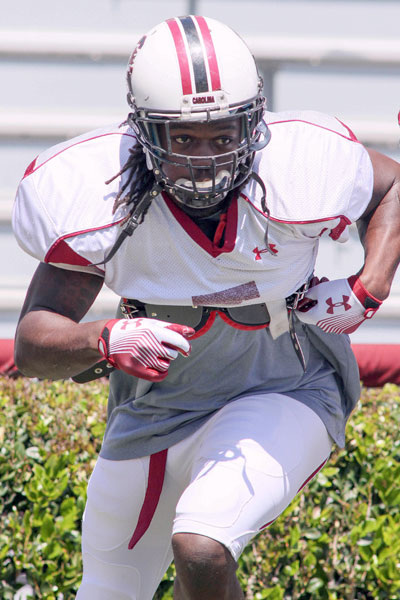
DE Jadeveon Clowney catches TD

COLUMBIA, S.C. — The most watched player at South Carolina got just one play at Saturday’s spring game.

And Jadeveon Clowney scored a touchdown.

[+] EnlargeJadeveon Clowney

Gamecocks coach Steve Spurrier had the All-American defensive end run the coach’s annual pass-to-someone-coming-off-the-sideline play. Clowney, wearing sneakers, shorts and no pads, caught the pass from freshman Connor Mitch, but awkwardly slipped as he turned for the end zone. However, the referee “missed” him hitting the ground, and Clowney threw the ball in the stands after the 54-yard touchdown.

Spurrier has always taken a breezy attitude to spring practice and his spring game. There are no real rosters — tight end Jerell Adams briefly led both the Black and the Garnett teams in receiving in the first half. Spurrier boosts scoring by having bonus kicks with just a snapper and holder after each quarter and the defenses can’t blitz and are limited to basic coverages.

“Spring practice is important for the younger guys. I guess one reason I don’t get all fired up for spring practice is I only went through one of them in my three years of them at Florida. I got hurt the other two — nothing serious,” Spurrier said of his days at quarterback with the Gators in the mid-1960s.

The Gamecocks are coming off back-to-back 11-win seasons and Spurrier thinks they have the talent to contend for the Southeastern Conference title again as long as hard work follows.

“I think we do have the chance to have a good team,” Spurrier said. “But it could go anywhere to winning season to big winning season to losing season.”

Plenty of eyes will be on Clowney, who is one of the most hyped defensive player in the country. Clowney sitting out Saturday wasn’t a surprise. Defensive coordinator Lorenzo Ward said before drills even started that Clowney wouldn’t be scrimmaging much, keeping with Spurrier’s spring practice philosophy of giving most of the work to younger players. Then the junior’s neck got stiff after a hit just before the last week of practice and the coaches decided he didn’t need to do anything else before the fall.

“Spring is really about learning the playbook,” Clowney said.

Plus, Clowney’s brand of havoc doesn’t transfer well when he is going against his own team. He hopes to make a Heisman Trophy push this year, helped by plays like the one hee made on Michigan’s Vincent Smith in the Outback Bowl. Clowney knocked Smith’s helmet, and the ball loose. The picture of the play is on the cover of the Gamecocks’ spring notebook.

“A guy that made the hit that keeps on hitting,” Spurrier said to the crowd as he led the halftime awards ceremony, which included Clowney getting the Ted Hendricks Award as the nation’s best defensive end from Hendricks himself.

Quarterback Connor Shaw also sat out the spring game as he recovers from foot surgery. Shaw, a senior is expected to share snaps with Dylan Thompson, a junior. Thompson played only one of the 12-minute quarters Saturday, going 6-for-10 for 96 yards and an interception with a 6-yard touchdown pass to Shaq Roland.

SEC blog

SEC
ESPN.com’s Chris Low and Edward Aschoff write about all things SEC football in the conference blog.

More:
• Blog network: College Football Nation

Spurrier “told me to expect to play a lot. Whatever that means, it means,” Thompson said. “But I think he has confidence in both myself and Connor that we aren’t going to look at it as a selfish thing. Obviously I know Connor is here, and he knows I am here.”

Elsewhere on offense, the Gamecocks have questions. Spurrier needs receivers to step up to replace Ace Sanders, who left early for the NFL. The Gamecocks also have to replace running back Marcus Lattimore, who also left early after missing half of last season with a knee injury.

Spurrier will likely use sophomores Mike Davis and Brandon Wilds regularly in fall. Davis carried the ball twice, including a 25-yard TD run. Wilds had seven carries for 31 yards.

The tight ends are solid, with Spurrier happy that even fourth string Jeff Homad caught a TD pass. The rest of the offensive line has more questions, leading to the best Spurrier quote of the spring at a practice earlier this month.

“Offensive line has got to learn how to block. They’re pretty good at everything except blocking. Unfortunately, that’s all we ask them to do,” Spurrier said.

Even with Clowney prowling up front, there are questions on defense. The Gamecocks lost all their starting linebackers. It is much tougher to judge any progress the defense makes in spring because Spurrier keeps a leash on the hitting. Freshman free safety Chaz Elder did have two of the defense’s three interceptions, and freshman strong safety Kyle Fleetwood returned a fumble seven yards for a touchdown.

But Spurrier, who suffered through a 14-7 spring game right after he arrived at South Carolina nine years ago, wants to see plenty of offense in his scrimmages. For what it is worth, the Black beat the Garnet 44-30 this year.

“Coach Spurrier says, if you have all the fans out here like we had today, they want to see points on the board,” said Ward, who just goes along with Spurrier’s show. “Me, as a defensive coordinator, I hate to see points on the board. Hopefully you saw as many points on that board today as you are going to see all season.”

Copyright 2013 by The Associated Press

Brains as Clear as Jell-O for Scientists to Explore

Scientists at Stanford University reported on Wednesday that they have made a whole mouse brain, and part of a human brain, transparent so that networks of neurons that receive and send information can be highlighted in stunning color and viewed in all their three-dimensional complexity without slicing up the organ.

Even more important, experts say, is that unlike earlier methods for making the tissue of brains and other organs transparent, the new process, called Clarity by its inventors, preserves the biochemistry of the brain so well that researchers can test it over and over again with chemicals that highlight specific structures and provide clues to past activity. The researchers say this process may help uncover the physical underpinnings of devastating mental disorders like schizophrenia, autism, post-traumatic stress disorder and others.

The work, reported on Wednesday in the journal Nature, is not part of the Obama administration’s recently announced initiative to probe the secrets of the brain, although the senior author on the paper, Dr. Karl Deisseroth at Stanford, was one of those involved in creating the initiative and is involved in planning its future.

Dr. Thomas Insel, director of the National Institute of Mental Health, which provided some of the financing for the research, described the new work as helping to build an anatomical “foundation” for the Obama initiative, which is meant to look at activity in the brain.

Dr. Insel added that the technique works in a human brain that has been in formalin, a preservative, for years, which means that long-saved human brains may be studied. “Frankly,” he said, “that is spectacular.”

Kwanghun Chung, the primary author on the paper, and Dr. Deisseroth worked with a team at Stanford for years to get the technique right. Dr. Deisseroth, known for developing another powerful technique, called optogenetics, that allows the use of light to switch specific brain activity on and off, said Clarity could have a broader impact than optogenetics. “It’s really one of the most exciting things we’ve done,” he said, with potential applications in neuroscience and beyond.

“I think it’s great,” said Dr. Clay Reid, a senior investigator at the Allen Institute for Brain Science in Seattle, who was not involved in the work. “One of the very difficult challenges has been making the brain, which is opaque, clear enough so that you can see deep into it.” This technique, he said, makes brains “extremely clear” and preserves most of the brain chemistry. “It has it all,” he said.

In the mid-2000s, a team led by Dr. Jeff Lichtman at Harvard developed a process called Brainbow to breed mice that are genetically altered to make their brain neurons fluoresce in many different colors. The new technique would allow whole brains of those mice with their rainbow neurons to be preserved and studied.

“I’m quite excited to try this,” Dr. Lichtman said.

There are several ways to make tissue transparent. The key to the new technique is a substance called a hydrogel, a material that is mostly water held together by larger molecules to give it some solidity.

Dr. Chung said the hydrogel forms a kind of mesh that permeates the brain and connects to most of the molecules, but not to the lipids, which include fats and some other substances. The brain is then put in a soapy solution and an electric current is applied, which drives the solution through the brain, washing out the lipids. Once they are out, the brain is transparent, and its biochemistry is intact, so it may be infused with chemicals, like antibody molecules that also have a dye attached, that show fine details of its structure and previous activity.

Techniques like this, said Dr. Insel, “should give us a much more precise picture of what is happening in the brains of people who have schizophrenia, autism, post-traumatic stress disorder, bipolar disorder and depression.”

The tricky part was getting the right combination of temperature, electricity and solution. And it was very tricky indeed, said Dr. Chung. Over the course of years spent trying to make it work, he said, “I burned and melted more than a hundred brains.”

But with the paper’s publication, the recipe is now available to anyone who wants to use it, and, he said, “I think it will be relatively easy.”

The technique has its limits, of course. Dr. Chung said more work needed to be done before it could be applied to a whole human brain, because a human’s brain is so much larger than a mouse’s, and has more lipids.

Dr. Chung said he planned to start his own lab soon and to work on refining the technology. But he pointed out that it is already known that it works on all tissue, not just brains, and can be used to look for structures other than nerve cells. On his laboratory bench, he said, “I have a transparent liver, lungs and heart.”

Dr. Reid agreed that Clarity had applications in many fields. “It could permeate biology,” he said.

This article has been revised to reflect the following correction:

Correction: April 10, 2013

An earlier version of this article misstated Dr. Clay Reid’s work with Dr. Jeff Lichtman of Harvard. Dr. Reid was involved in Dr. Lichtman’s Connectome Project, not on the Brainbow team.